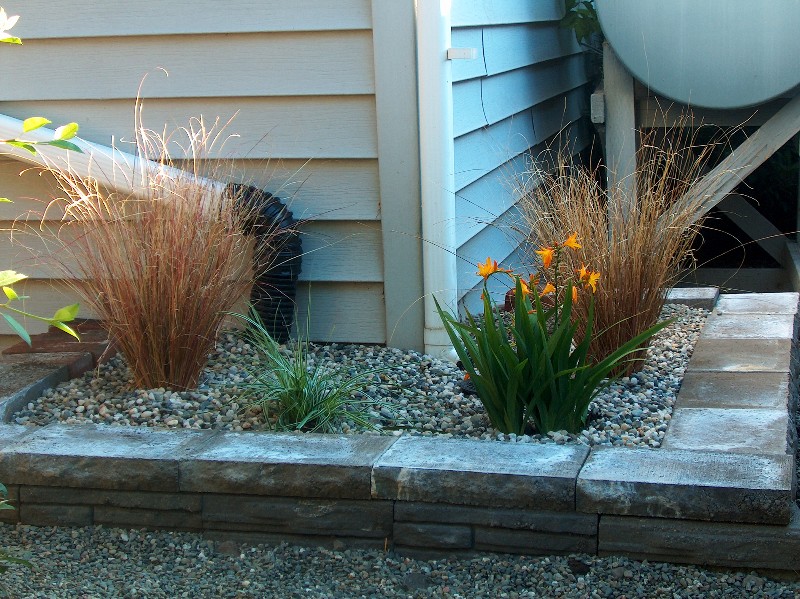
The stormwater chain is comprised of many components that can be put together in various combination's to suit your particular garden or landscape.
The stormwater chain composition includes bioretention facilities, stormwater gardens and rain chains, rills and channels to rainwater harvesting and living roofs. By utilizing just one of these elements, you can help reduce stress on existing and overwhelmed stormwater drainage systems by breaking the conventional drainage chain of impervious surface (such as roof or pavement) to sewer.
Green roofs, as I will refer to them in this post, are layers of living vegetation installed on tops of buildings or structures. They manage run-off by reducing run-off flow rates from small to moderate storms and they also provide cooling in the summer months and reduce heat loss in the cooler winter months.
Green roofs are typically referred to as “intensive” or “extensive”. An extensive green roof is more lightweight designed for shallow root systems like sedum and moss communities and are easier to engineer and retrofit older, thinner roofs. Intensive green roofs can sustain larger shrubs and small trees and conifers. Green roofs can be biodiverse and visually pleasing, not monochromatic and boring as was the case in the earlier turf or grass roofs of Scandinavian log cabins.
When you plan your green roof, typically it contains a waterproof layer (membrane), a drainage layer, geotextile filter mat, the substrate (growing medium) and your vegetation referred to as your living elements. The simplest approach to planting is using smaller sized plugs or already grown tiles that can be supplied by certain garden centers. These plugs and / or tiles are planted directly into your substrate.
Green roofs are critical in reducing the amount of run-off that reaches our stormwater drainage systems, taking the strain off of older stormwater systems and deteriorating infrastructures in most urban areas. With roofs representing 40 – 50% of the impermeable surfaces in urban areas, you can see the potential role green roofs can play in reducing run-off.
Next week I will discuss another major component in the stormwater chain- capturing water run-off with landscape swales.
Flora Pacifica's blog discussing new trends, ideas and events from floral to responsible and sustainable landscape practices
Tuesday, April 3, 2012
Tuesday, March 13, 2012
Permeable Pavers: How to Sustainably Manage Water in Your Designed Greenspaces (Third in a Series)
Permeable Pavers:
Encourage Groundwater Recharge
The need to create greater environmental awareness
in dealing with water conservation is evident and by understanding and implementing
some of these simple principles, it gives real meaning to all the decisions
that we make about how a landscape is planned and that we are doing something
positive which we have control.
Permeable
landscape pavers, grid style, first appeared in the landscape in Germany in
1961. Now some fifty years later, yes I
said fifty, permeable pavers are still being treated like a new idea.
There are many styles of permeable pavers,
from the typical grid pavement for occasional use (typically seen with a
cultivar of grass growing through them), to the concrete cast pavers that create a ¼” minimum open joint,
providing interstitial spaces for gravel and drainage (ref. above photo).
Designing sites to respect natural drainage
patterns, minimize impermeable surfaces and maximize stormwater infiltration
can help protect site and regional hydrologic systems by reducing downstream
impacts and recharging groundwater. By
implementing permeable pavers along with stormwater planters and rain gardens
and vegetated swales, we can slow down sheet flow, allowing the stormwater to
infiltrate and reduce downstream impacts.
Since landscape pavers are constructed on a monolithic sub-base, pavers
withstand our areas freeze and thaw conditions without any issues when
installed correctly. These permeable
pavers have a veneer surface that will withstand standard ice melt applications
and should have an average life span of 25 years under normal conditions. Permeable pavers are also play a major role
in sustainable site design and are LEED (Leadership in Energy and Environmental
Design) accredited, LEED NC 2.2 SS Credit 6:1:
Stormwater Design: Quality Control
Resources Stormwater Best Management Practice
Design Guide, EPA / 600 / R-04/ 121A, September 2004
Wednesday, February 29, 2012
Rain Gardens: How to Sustainably Manage Water in Your Designed Greenspaces (Second in a Series)
Stormwater Planters
It is easy to come across as being pious and sanctimonious when dealing with environmentally – friendly design, and also to be perceived as spreading dire messages of impending disaster if we don’t change our ways. The need to create greater environmental awareness in dealing with water conservation is evident and by implementing some of these simple principles such as stormwater planters and rain water harvesting, it gives real meaning to all the decisions that we make about how a landscape is planned and we are doing something positive which we have control.
Stormwater planters are exciting and relatively new development in rainwater management. They were pioneered in Portland and are described in the Portland Stormwater Management Manual (2004) as ‘structural landscaped reservoirs’. They are essentially above – ground boxes partially filled with soil in which plants are grown (ref. photo). These planters provide a means of bringing planting and vegetation into the smallest of schemes and offer a creative alternative to the ubiquitous foundation planting at the base of your home.
Stormwater planters take rainwater straight from the structure’s roof as the downpipes empty directly into the planters. If the inflow rate exceeds the infiltration rate, then ponding will occur near the top of the wall level, allowing this water storage to attenuate flow. Excess water can then exit the planter at the overflow near the top of the planter diverted into other vegetated areas adjacent the stormwater planter, infiltrating into the ground. The design aim is that water does not remain in the planter for more than 12 hours- preferably draining through the planter within a 2-6 hour window, reducing the possibility of anaerobic conditions, which are detrimental to plant growth.
Stormwater planters create more than just an
opportunity for rainwater management and planting, they allow us to think of
these structures as ways to organize and arrange outdoor space. Next week we will discuss various rain water
harvesting methods and formulas for calculating how much water you can
harvest. Please follow us on Twitter: Http://twitter.com /florapacifica
Sunday, February 19, 2012
Rain Gardens: How to Sustainably Manage Water in Your Designed Greenspaces (First in a Series)
Without water we wouldn’t have gardens. Water brings our gardens and landscapes to
life. When the concept of gardens
designed purely for pleasure in the ancient cultures of the Middle
East, water was a precious resource. Some of the early gardens represent a lush
green (water-fed) vision of perfection to an arid surrounding. Water has always been a magnet, an
indispensable ornamental element in gardens, and now, more recently, the
presence of water has been seen as essential for creating a balanced habitat, a
bird friendly garden to attract wildlife as well as providing pleasure for
people. Water is a finite and
unpredictable resource and is now the epicenter of our planning and design
thought process for our gardens and landscape.
Ultimately, the presence or absence of water dictates what is possible.
Technically, a rain garden is a very specific,
planted depression that is designed to take all, or as much as possible excess
rainwater run-off from the non permeable pavement, house or other building and
its associated landscape. In this
series, I will use a more evocative approach, with a broader definition,
covering more possible elements that can be used to capture, channel and make
the most of the natural rain fall. The
idea is that all of the individual elements that we deal with are small-scale
rain gardens in themselves. Rain gardens
promote planting and the more diverse or complex the planting, the greater the
benefits. Replacing paved surfaces or
intensively managed turfgrass with mixed naturalistic planting will greatly
increase the wildlife and habitat value of a garden.
Although native plants make a major
contribution to this naturalistic planting, rain gardens include plants from
other regions, and when natives, flowering perennials and grasses with
scattered shrubs are designed properly, you will create an ideal mix for
encouraging a great diversity of wildlife.
Reality speaking, garden biodiversity is not the just the visible and
attractive things we like- birds and butterflies, it is about the things we
can’t see- insects and invertebrates, hidden in the soil or vegetation. Rain gardens are particularly useful for
supporting that greater biodiversity.
Next blog I will discuss Stormwater Planters, methods and techniques.
If you have any questions or would like to read on other sustainable topics pertaining to the landscape, please email me at eric@florapacifica.com
Monday, February 13, 2012
Xeriscaping- Just The Facts
Xeriscaping (NOT ‘Zero-scaping’) is a method of
water-prudent landscaping created by the Denver Water Department in 1978 and is
a registered trademark of Denver Water.
The
word xeriscaping is a portmanteau of xeros (Greek for "dry") uses
plants that are tailored to the native climate of a region, coupled with other
water-saving design ideas. In many
cases, especially in the West, this means getting rid of thirsty plants and sod
in favor of more drought-resistant foliage.
In a conservative community such as ours, some people just don’t want to
let go of traditional landscaping, but with the ever rising water and sewer
rates and the fact that 50% of our potable drinking water is used to irrigate
our landscape, it is time to break away from this traditional thinking. Xeriscaping, when implemented correctly and
with knowledgeable professionals, can decrease your landscape water usage by
nearly 45% within 3 years. Another large
benefit of a xeric landscape over a traditional landscape is the reduction in
maintenance costs. On an average, you
will reduce the time necessary to maintain a xeric – style landscape and reduce
maintenance costs 30% over a traditional landscape. As your xeriscape landscape matures, your
time management will allow you to do more enjoyable things for the day to day
maintenance will continue to decrease.
Xeriscape just looks more harmonious, more in tune
with the landscape of the West overall.
We can show people there are exciting and colorful waterwise plants
available to the consumer, plants that are very colorful and appropriate for
our climate and elevation and the results will be aesthetically pleasing and
rewarding. Rewarding in a sense of
ecological responsibility and knowing that your xeriscape is fire wise,
attracts charismatic wildlife and saves water while increasing your investment. A Waterwise landscape is also rewarding in your
pocket book as well since the average cost per square foot for a xeriscape
garden averages out to be nearly $1.89 per sq foot less than a traditional
landscape. Water conservation is
becoming a normal way of life, especially in the west as groundwater reserves
are being depleted and communities are forced to look beyond their borders for
viable water sources and this can lead to conflicts with other
communities. Xeriscaping is quickly
becoming the normal and responsible means of landscaping and not only in the
West, but in other regions of the country as we just aren’t getting enough
consistent and reliable rainfall from year to year.
Wednesday, February 8, 2012
Sustainable Gardening in Small Spaces
Choosing the right layout (shape) of your garden
will save space, reduce labor, and create a better balance for plants and
pollinators. The shape of a garden
determines how much area can actually be planted, sustaining a healthy
environment to maximize annual production.
For example traditional hedgerow gardening ‘pathways’ can consume a
large amount of your planting area opposed to thinking outside the proverbial
box and planting in a natural pattern where pathway usage is reduced 8
fold.
Vegetable and herb gardens do not have to be planted in straight rows, they can have curves and movement and in some cases vertical movement (as I will explain a little later). Constructing a planting area in a round shape with a central pathway can maximize a small space and offer a great diversity of planting options. Referring this type of planting as a ‘zone’ system, the plants that are harvested frequently should be planted closest to the pathway. This would include your herbs for instance. The second course you would then install vegetation that gets picked regularly over the growing season, such as your tomatoes, eggplant and beans. Finally your outer area would be the ‘one and done’ plants such as potatoes, lettuce, etc. This type of gardening creates endless possibilities and as I have found, being creative not only adds excitement to something that may normally fee mundane and repetitious from year to year.
There is no limit to design and creative possibilities such as planting small fruit trees and perennial nitrogen-fixer plants that could provide good wind-and-weed barriers.
Now let’s think totally outside the box and
maximize a very small space to build a spiral herb garden 5’ across at the base
rising to a height of 3’ above grade. A
spiral garden approximately 5’ across by 3’ in height would equal 27 linear
feet of pathside plants. To construct
this style of garden, all you need is a mound of good soil and some melon sized
boulders inserted in a spiral pattern winding inward from the bottom. By constructing a vertical greenspace, you have
now created slopes that face in all directions, providing you great versatility
in your herb choices, ranging from part sun / shade to full sun. Also, the soil at the bottom of this spiral
will stay wetter than at the top, so plant accordingly and have fun this spring
with your creative side and get the children involved.
Sunday, February 5, 2012
Tree of The Week: Amelanchier laevis ‘Spring Flurry’
Botanical: Amelanchier laevis ‘Spring Flurry’
Common: Spring Flurry Serviceberry
Plant Details: Semi-Desert
Plant Community
Medium Street Tree 20’
Spread x 28’ Height
Sun to Part Shade
White Cluster Blossoms
in Spring
Dominant Central Leader
15-20” inches of Annual
Precipitation to Establish
Habitat Facts: Street Tree
Bird Cover, Food Source
Edible 3/8” Berries
Provide Banquet for Birds
Hardy to Zone 4
General Notes: Perfect
Medium Tree for Bird Habitat, Naturalizing
Does Not Like Alkaline Soils
Maintenance Tips: Prune Interior Branches after 5 Years
Please
send in your questions to eric@florapacifica.com
and answers will be posted in next week’s blog post
Subscribe to:
Posts (Atom)